AWS Security Best Practices: Securing Your AWS Cloud
Understanding AWS security best practices is essential for protecting sensitive data and automating security measures. This guide simplifies cloud security challenges and emphasizes the importance of regulatory compliance. Reducing weaknesses in data management strengthens cloud environments and builds customer trust.
Working with Amazon facilities, it is necessary to implement AWS security best practices to ensure the safety of the data and the cloud.
The digitalization drive has become the dominating trend, with computer technologies penetrating all spheres of social and personal life in the modern world. Alongside ushering in innumerable benefits, the ubiquitous advent of IT devices has brought severe concerns. One of the most pressing questions that worries both individuals and organizations is, ‘How secure is my virtual data?’
Public anxiety is continuously fed by reports of security breaches and data leakages that cost companies a pretty penny. Their financial losses manifest an ever-growing pattern, with businesses having to spend (or waste?) millions of dollars to redress gruesome consequences.
For example:
– Desjardins Group lost over $155 million to cover their client’s data leakage.
– Norsk Hydro had to fork out $75 million to eliminate the effects of a cyberattack.
Such exorbitant losses are rare, but IBM experts believe that, on average, corporate victims of cybercrime have to foot the bill equal to $4 million for data breaches.
Because of such appalling statistics, establishing cybersecurity in their IT environment is prioritized by many organizations. Even the malicious onslaught of the global pandemic didn’t relegate security considerations to a secondary place, with companies reluctant to cut down on security strategy enforcement expenditures.
‘Cybersecurity’ is an umbrella term that subsumes different approaches and measures depending on the targeted elements of the digital environment. Thus, providing security for the operating systems and cloud facilities has its peculiarities.
The Difference between Cloud and IT Security in General
Some basic steps are common for any IT network: identification of bottlenecks, asset protection, malicious activity detection, vulnerability management, breach responses, recovering procedure, etc. However, experts must know this environment’s unique aspects while planning cloud infrastructure security measures.
The openness of cloud facilities to adding new infrastructure and consequently related security vulnerabilities
Once a person has the right credentials, they can finetune the cloud network, and there is a slim chance to be sure that this person’s security awareness is on an adequate level. So, having been quite secure at the outset, the modified version of the cloud infrastructure may become vulnerable to safety threats
Rapid changes within cloud environments necessitate constant updating of security measures
With autoscaling and serverless computing making their robust entrance into the modern cloud reality, conventional security mechanisms like vulnerability scanning become ineffective at detecting swift-appearing breaches.
This problem becomes more serious when hybrid or multi-cloud environments are involved, so security teams must coordinate and harmonize their steps and strategies.
Shared security responsibilities between the cloud service provider (CSP) and customers
Typically, a CSP is responsible for hardware safety, maintenance, configuration management, updating, patching the OS, and configuring available cloud services. All other security issues are to be handled by customers
Blue-chip cloud providers pay close attention to the latter point. For instance, Amazon Web Services security best approaches include a special scheme delimitating all stakeholders’ responsibilities.
But AWS best security practices aren’t the only reason for this platform’s popularity.
Is AWS Cloud Secure?
Amazon Web Services (AWS) is a comprehensive platform that has won universal acclaim as a reliable cloud facilities provider offering (alongside configuration management and data storage on managed databases like Oracle and MySQL) simple storage service a whole gamut of AWS consulting services.
The latter include content delivery, dynamic website hosting, running servers (both web and app) in the cloud, and computer power, to name a few.
Each service can be tailored to match every user’s unique needs and may be accessed from any place with internet coverage. It is no wonder that AWS environment ranks first among all CSPs.
As you can see, cloud infrastructure market size continues to grow, and AWS keeps its market share at 34%. By September 2022 cloud infrastructure service revenues hit $217 billion.
The business reputation of AWS is, to a significant degree, attributed to robust Amazon cloud security policies.
How is security in AWS handled?
First, AWS security best practices are based on the above-mentioned shared responsibility model, allowing the vendor to direct additional resources to enhance their share of the security burden
Secondly, AWS security in the cloud is enforced via a set of AWS security tools, each playing a specific role in security posture.
- Thus, CloudHSM provides Amazon cloud storage security by generating data encryption keys;
- Amazon Cogito spots brute force authentications and sham login attempts;
- CloudTrail monitors and records API requests;
- CloudFront serves as DDoS attack protector,
- Amazon Inspector assesses the security of your apps.
The employment of such AWS security services standards makes the platform as safe as for multiple AWS accounts, any on-premises network, provided customers watch their area of liability closely. But however careful both parties to the security protocol might be, they must be aware of potential bottlenecks that can render their security efforts inadequate.
Importance of cloud security for business
You must protect your company and its clients from harmful attackers. As enterprises migrate more important workloads and sensitive data to the cloud, the need for good AWS security and risk management grows
Another reason for good AWS security is the reputational harm that might result from a preventable catastrophe.
According to Gartner, 99% of cloud security breaches will be the client’s fault by 2025. Customers’ trust may be shaken if they realize that a company has been compromised due to an easily avoidable blunder, and they may decide to take their business elsewhere.
With AWS Cloud security, you can:
Scale safely with more visibility and control
With AWS, you have complete control over where your data is stored, who has access to it, and what resources your company uses at any time. Fine-grained identification and access restrictions, together with continuous monitoring for near real-time security information, guarantee that the correct resources can access the right information at all times.
Automate and reduce risk with AWS services
By automating security processes on AWS, you may be more secure by avoiding human configuration mistakes and allowing your team more time to focus on other important business duties. Choose from a wide range of integrated solutions that automate processes creatively, allowing your security team to collaborate more closely with developer and operations teams to produce and release code more quickly and securely.
Build with the highest privacy and data security standards
You can develop the most secure global infrastructure with AWS, knowing that you always own your data, including the flexibility to encrypt, relocate, and manage retention. Before leaving our secure facilities, all data moving across the AWS global network that connects our data centers and company automatically encrypts regions at the physical layer. There are further encryption layers, such as all VPC (virtual network that reaches the network of traditional data center) cross-region peering traffic, and customer or service-to-service TLS communications
Expand and develop, keeping your environment safe with the AWS Cloud
You will profit as an AWS client from data centers and network architecture created to satisfy the needs of the most security-conscious enterprises. To defend the privacy, security data integrity, and accessibility of our customers’ data, AWS Cloud Security constantly watches over it.
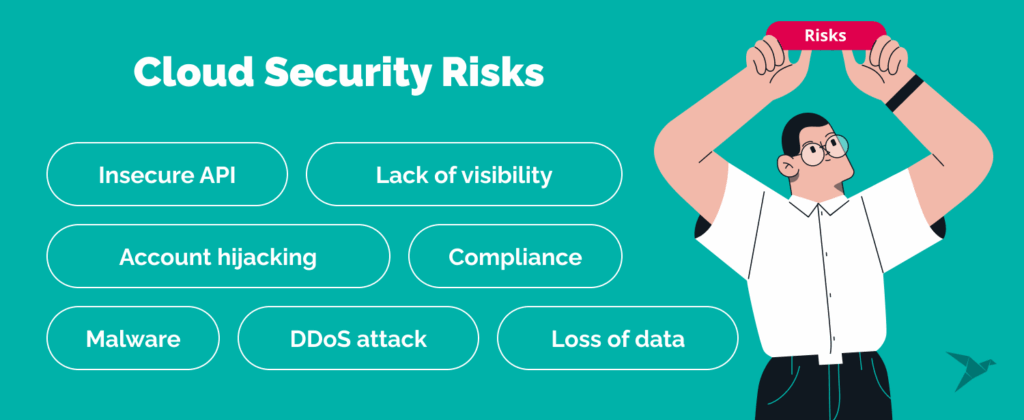
Cloud security risks
Security in the cloud at AWS is the highest priority. But do you know all the security risks you might face? Keep reading!
Insecure API
The API may be the sole asset having a publicly known IP address, making it the most exposed. The necessity to hand over API credentials to outside parties may force organizations to expose their credentials to further detection, adding to the complexity of cloud security. Additionally, suppose an attacker gets their hands on a token that a client uses to access a cloud-based service.
DDoS attack
The operating system resources are overloaded when a DoS attack occurs. A lack of resources for scaling carries numerous performance and stability problems. It might indicate that an application is operating slowly or simply is unable to load correctly. User accounts perceive it as being congested traffic. The company’s mission is to locate and eliminate the origins of the interruption. They have also boosted expenditure on resource utilization.
Compliance
As data privacy becomes more of a concern, compliance rules and industry standards such as GDPR, HIPAA, and PCI DSS become increasingly strict. One element to ensure continuing compliance is to monitor who has access to data and what they can do with that access. Because cloud systems often allow for large-scale user access, monitoring access throughout the network can be difficult if the right security measures (i.e. access restrictions) are not in place.
Loss of data
Data leakage is a major worry for businesses, with more than 60% ranking it as their top cloud security risk. As previously stated, cloud computing necessitates enterprises ceding some control to the CSP
If a breach or attack occurs at the cloud service provider, your company will not only lose its data and intellectual property. Still, it will also be held liable for any related damages.
Lack of visibility
An organization’s cloud-based resources are situated outside the corporate network and run on infrastructure the firm does not own. As a result, many traditional network visibility techniques are no longer viable in cloud settings, and some businesses lack cloud-focused security capabilities. It can hinder an organization’s capacity to manage and defend its cloud-based resources.
Malware
Moving significant volumes of data to an internet-connected, virtual private cloud, environment exposes enterprises to extra security dangers. According to an IBM report, malware assaults are major cloud security concerns.
Research indicates that over 90% of firms are more likely to encounter data breaches as cloud usage grows. Organizations must be mindful of the expanding threat landscape as hackers grow more sophisticated in their attack delivery tactics.
Account hijacking
As enterprises increasingly rely on cloud-based infrastructure and apps for critical business processes, account hijacking is one of the most significant cloud security challenges. An attacker accessing an employee’s credentials can access critical data or functionality, and compromised customer credentials grant complete control over multiple accounts.
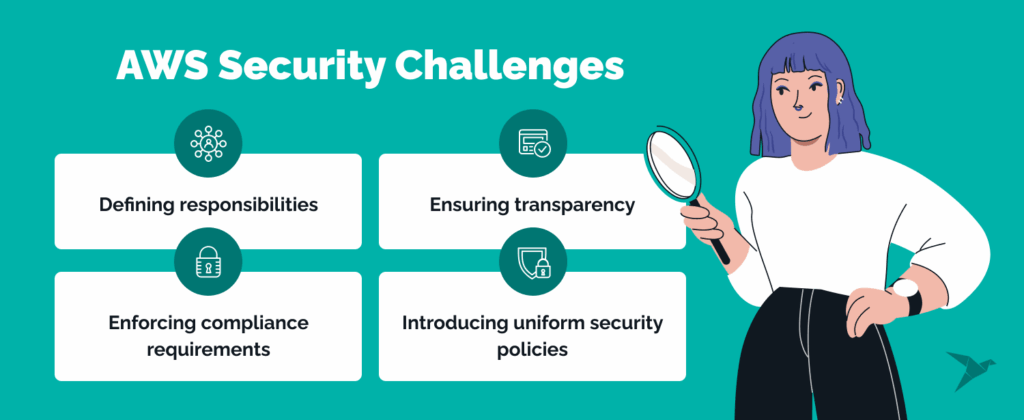
AWS Security Challenges
What should security specialists pay special attention to in security and compliance?
- Defining responsibilities. There should be a clear understanding between stakeholders of what they do to provide security for the entire system. Otherwise, security gaps will appear, threatening infrastructure integrity in the cloud and increasing cyberattack risks. Conventionally, customers are responsible for their data (and its encryption), network traffic configuration and protection, authentication and access management, and file system encryption. All the rest is entrusted to the provider.
- Ensuring transparency. With multiple-cloud approaches practiced by many organizations today (and often with insufficient knowledge in the field), it becomes increasingly hard for their security experts to supervise all cloud deployments. CSP security solutions may vary, which turns maintaining consistent visibility across deployments into a challenge. To address it, companies must introduce universal security solutions enabling transparency of all cloud-based deployments hired by the organization.
- Enforcing compliance requirements. Typically, organizations develop regulations for storing and protecting sensitive data. Yet, the absence of control over the rented cloud infrastructure makes maintaining respective measures more problematic. So, while selecting a CSP, companies should see that the provider’s data security regulations match their principles as much as possible.
- Introducing uniform security policies. If you employ other AWS consulting services providers’ in addition to Amazon, AWS infrastructure security best practices become insufficient. Keeping consistent security strategies when dealing with multiple clouds adds headaches to security departments. The problem can be solved by creating a single security management platform that enables monitoring and controlling all cloud environments the organization rents.
Armed with an awareness of the possible challenges, you can start implementing AWS security features.
AWS Security Best Practices Checklist
Start with Planning
A security strategy must be developed once you consider migrating to the cloud. Trying to stop the gaps and feel the breaches on the hoof spells hurried makeshift measures. And when security is concerned, more haste, less speed.
Know Thy Ground
Security teams must know the differences between the on-premises and cloud resources. For instance, forbidding developers to introduce infrastructure changes, which works well for the on-premises network on premises environments, in the cloud would limit opportunities offered by cloud facilities and severely handicap their efficient usage by the organization. So replicated the on-premises security experience is out of the question when dealing with the cloud.
Don’t Neglect Native Resources
By leveraging Amazon’s built-in tools and the best practices for AWS cloud security will not only reduce the amount of work your security team will have to perform but will strengthen the defense of your environment with tested and reliable mechanisms.
Make Your Security Policy Comprehensive
Your security policy must include across-the-board measures encompassing AWS accounts, credentials, roles, IAM users, and groups. Only if you embrace them will your cloud environment protection system function properly.
Implement User Access Control
Several measures can ensure the access control to the AWS environment is restricted to authorized persons only. To do that, you should avoid allowing users to create AWS accounts with the email address (so-called root users) and attach policies to individual users (instead of groups and roles). All AWS infrastructure access of your staff should be effected through federated SSO accompanied by strong passwords and MFA. Besides, unused credentials must be disposed of, and access keys need rotation at least once every three months for security in the cloud.
Define Password Policy
Password cracking is by far the most common penetration attack undertaken by cybercriminals, so this segment of the protective perimeter should be watched very closely. Use complex passwords suggested by generators, introduce multi-factor authentication, establish automatic lockout in case of several failed login attempts, and renew passwords once in a short while (within 60 days or so).
Make Data Encryption a Rule
Even if a wrongdoer penetrates your environment, the encrypted data (especially sensitive ones) form the second line of defense. Alongside employing native AWS encryption tools you can use scalable key management to perform various operations with encryption keys (creation, rotation, and auditing included).
Remember to Backup Your Data Regularly
AWS environment offers native solutions (AWS Backup, Amazon RDS, Amazon EFS, AWS Storage Gateway, and others) that are instrumental in performing backups of databases, storage volumes, and file systems.
Systematic Security Policies Updates and Open Access is a Must
The documents related to the security identity the company’s security policies arSystematic Security Policies Updates and Open Access is a Must
east of the latest security practices are also mandatory.
FAQs

1. What are the security risks of cloud computing?
The most common security risks of cloud computing are limited visibility into network operations, insecure integration and APIs, data loss, data breach, DDoS attacks, account hijacking, compliance, and malware.
2. How does AWS face cloud security threats?
AWS cloud security includes AWS identity and access management, addresses the issue, follows security visibility, detects all possible risks, and protects underlying infrastructure, data, network and application, and compliance.
3. How is the security provided for web applications hosted in the AWS cloud?
AWS services safeguard all your cloud resources (data, accounts, and workloads) from unwanted access. AWS data security services include encryption, user authentication, key management, and threat detection, which monitors and protects your accounts and workloads in real time.
4. Why is AWS cloud security the best?
AWS resources enable you to automate manual security activities, allowing you to focus on developing and innovating your organization. AWS’s extensive services and features (scanning for vulnerabilities and malware, applying file integrity monitoring, and monitoring user access and activity) increase capacity to satisfy fundamental security and compliance needs and secure access such as data localization, protection, and confidentiality.
Content Credit
Roman Kolodiy